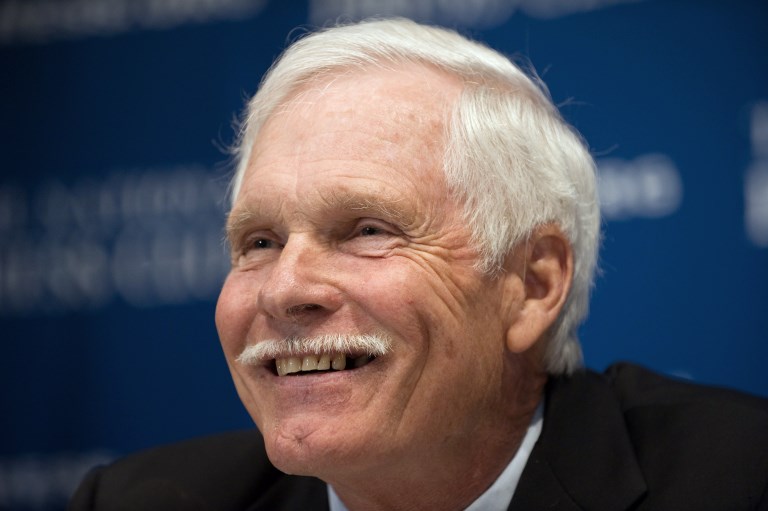
(FILES) In this file photo taken on April 19, 2011, CNN founder Ted Turner participates in a debate on US energy policy with BP Capitol founder T. Boone Pickens at the National Press Club in Washington, DC. Turner revealed he is battling Lewy body dementia, a neurodegenerative disease that alters memory, mood, movement and behavior. In an interview to air on September 30, 2018, on CBS, the 79-year-old Turner opened up about his battle, and even struggled to remember the name of the disorder. / AFP PHOTO / Nicholas KAMM
Ted Turner, the pioneering media executive who transformed global broadcasting by launching 24-hour television news and building a vast cable empire, has died at the age of 87.
A family spokesman confirmed that Turner died on Wednesday at his home near Tallahassee.
He had disclosed in 2018 that he was living with Lewy body dementia.
 Turner speaks on stage outside of the Techwood Campus promoting the launch of CNN on June 1, 1980
Turner’s most enduring legacy was the creation of Cable News Network in 1980, which revolutionised television journalism by introducing round-the-clock news coverage.
The model reshaped how audiences consumed information and set a standard later adopted across the global media industry. He subsequently expanded the network into CNN Headline News and CNN International, extending its reach worldwide.
His influence stretched far beyond the news. Turner built a portfolio of cable channels, including TBS and TNT, and later launched Turner Classic Movies following his acquisition of the MGM film library in 1985.
A similar strategy underpinned the creation of Cartoon Network in 1992 after he purchased the Hanna-Barbera catalogue.
 In 1996, Turner sold his company to Time Warner for $7.34 billion. He became vice chairman after the merger.
In 1996, he merged Turner Broadcasting System with Time Warner, forming one of the largest media corporations of its time.
An entrepreneur known for bold and often risky decisions, Turner frequently pushed the boundaries of the industry, at times coming close to financial collapse before rebounding. He also ventured into sports, captaining the winning yacht in the America’s Cup and owning the Atlanta Braves, which he helped popularise through national television broadcasts.

Turner’s personality was as prominent as his business achievements. Nicknamed the “Mouth of the South” for his outspoken style, he was known for grand ambition.
“I’m trying to set the all-time record for achievement by one person in one lifetime,” he once said.
Even rivals acknowledged his impact; media magnate Rupert Murdoch described him as one of the most influential figures in modern media.
His interests extended into philanthropy and conservation. Turner donated $1bn to the United Nations and became one of the largest private landowners in the United States, setting aside vast tracts for environmental preservation.
 Turner and Jane Fonda arrive at the 62nd Annual Academy Awards on March 26, 1990.
His personal life, however, was often turbulent, marked by high-profile relationships, including his marriage to Jane Fonda, and a reputation for controversial remarks and unpredictable behaviour. His political views were similarly complex, spanning conservative affiliations while maintaining relationships with figures such as Fidel Castro.
Despite the controversies, Turner’s influence on the media remains profound.
His creation of continuous news coverage altered the pace and nature of journalism, ensuring that major global events, from geopolitical upheavals to wars, could be followed in real time. Reflecting his outlook, Turner once remarked: “I’ve always been more of an adventurer than a businessman.”
 After turning the family business around and renaming it the Turner Communications Group, Turner purchased two independent UHF television stations — in Atlanta and Charlotte, North Carolina — in 1970. He named them WTCG and WRET, after his company and himself. WTCG eventually became WTBS, television’s first “superstation.” It used satellite technology to carry its signal nationwide.
 After his father’s suicide, Turner took over the family business, Turner Advertising Co.
A media mogul turned philanthropist

Turner always had a philanthropic streak, but it began to move to the forefront in 1997, the year after he sold Turner Broadcasting to Time Warner. That’s when he pledged $1 billion to the United Nations. Making good on that pledge took a while longer than he had anticipated – he made his final payment to the UN in 2015 – thanks to the beating his fortune took after the 2001 merger with AOL.
When it was over, he was still a billionaire, but just barely.
 Turner at his Flying D ranch in Montana in 2011.
Turner didn’t do anything in a small way, including reinventing himself. He was the second biggest landowner in North America, with 2 million acres spread over 28 properties, including 19 ranches in Nebraska, Colorado, Kansas, Montana, New Mexico and South Dakota, as well as in Argentina. The first of his Ted’s Montana Grill restaurants opened in 2002, and now there are more than 40 in 16 states. He managed to bring bison back from the brink of extinction; he had the world’s largest private bison herd, with approximately 51,000 head.
His five children – Rhett Turner, Laura Turner Seydel, Jennie Turner Garlington, Teddy Turner and Beau Turner – serve on the board of the Turner Foundation. His other foundations include his United Nations Foundation, Nuclear Threat Initiative, Captain Planet Foundation and the Turner Endangered Species Fund.
Half a century ago, his father’s suicide thrust a $1 million billboard company into his hands. He often said that his father, who was 54 at the time he died, ran out of things to work toward. As a result, Turner was driven – relentlessly moving forward, never looking back.
Yet no matter how successful he became, Turner was often still trying to prove himself.
Fonda recalled how she cried when Turner told her about his childhood on their second date. They were driving around his 60,000-acre ranch in Montana, and he was passing the time, talking as he drove. Tears ran down her face.
