… Babalakin re-elected national president
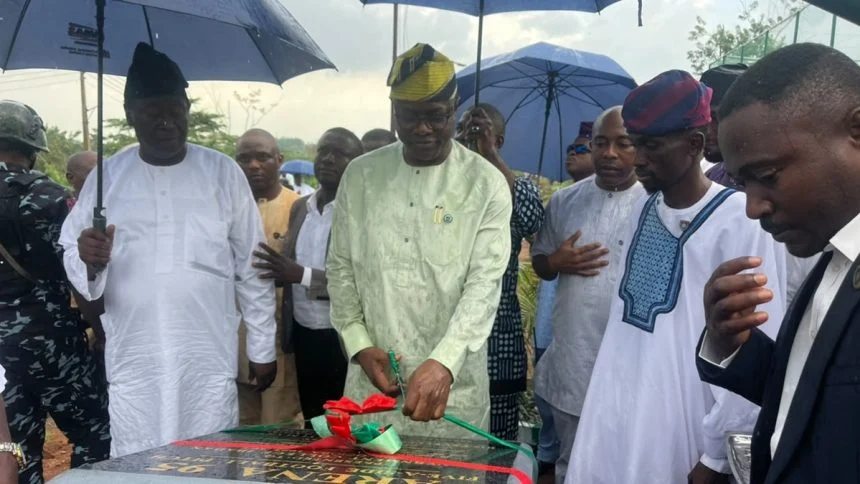
Oyo State Governor, Seyi Makinde, on Saturday commissioned new facilities at Government College Ibadan (GCI), praising the Old Boys Association (GCIOBA) for investing in the school’s infrastructure, digital learning and sporting facilities.
The commissioning formed part of GCIOBA’s 2026 reunion and Annual General Meeting (AGM), which began on Wednesday with a public lecture at Shell Hall, MUSON Centre, Onikan, Lagos.
Olawale Babalakin was re-elected as the association’s National President alongside other executives at the AGM.
The projects commissioned include the Jude Bademosi Cricket Oval, Imoyosi House, a hockey pitch and pavilion donated by the Babalakin family, and a tennis and practice court provided by the 1986 set.
Other facilities include a refurbished National Youth Service Corps (NYSC) lodge, a campus-wide Wi-Fi network, a command and control centre, a 270-capacity computer-based test (CBT) centre for technical education, refurbished chemistry and physics laboratories, and a five-a-side football pitch.
While commissioning the projects, Makinde commended GCIOBA for its investment in the school, noting that the facilities would support academic development, digital learning, technical education and sporting activities.
“The quality and standard of these facilities reflect the commitment of the old boys to improving their alma mater.
“These are not merely infrastructure projects; they are investments in the education and future of the students,” the governor said.
He noted that the refurbished science laboratories would provide students with improved facilities for practical learning, while the CBT centre and internet connectivity would expose them to digital tools and modern methods of assessment.
Makinde also highlighted the importance of the sporting facilities in helping students develop their talents, discipline and teamwork beyond the classroom.
“I congratulate the president and members of the Government College Ibadan Old Boys Association for their dedication to the school. The range of projects delivered demonstrates what can be achieved when people come together with a shared commitment to education,” he said.
In his address, Babalakin expressed gratitude to the Oyo State Government, led by Makinde, for granting the association the opportunity to develop, manage and operate the school.
“We must continue to reiterate our gratitude to the Government of Oyo State, led by His Excellency, Governor Seyi Makinde, for giving us the opportunity given to us,” Babalakin said.
He explained that the arrangement began with a two-year assessment period during which the association was expected to demonstrate its capacity to deliver on its commitments.
Babalakin said the association had adopted a structured approach to improving the school’s academic standards, combining infrastructure development with quality teaching, effective administration and high academic standards.
On his part, the president of the 1986 set, Ohimai Aikhije, highlighted the importance of the CBT centre for technical education, saying it would help students develop digital skills and prepare for further education and the workplace.
“The CBT centre is an important investment in the future of our students. Technical education requires practical knowledge, but students must also be familiar with the digital tools increasingly used for learning, assessment and professional development,” Aikhije said.
He said the centre would give students regular access to computer-based assessments and help them become more confident in using technology as part of their education.
“Our hope is that the centre will be a functional learning facility that students use regularly. It should help them acquire skills that will remain useful beyond Government College Ibadan and prepare them for the demands of a changing world,” he added.
The reunion’s opening event was the public lecture delivered by playwright and Professor of Theatre Arts, Femi Osofisan, an old boy from the 1959 set.
Nobel laureate Wole Soyinka, of the 1946 set, attended as guest of honour, while Ajibola Ogunshola, chairman emeritus of PUNCH Nigeria Limited, chaired the occasion.
The lecture, titled ‘From the Nobel to the Thalia Prize: GCI and the Making of Modern African Theatre’, was held under the theme ‘GCI, the Arts and National Development’.
During the lecture, Osofisan challenged Nigerians to look beyond political systems and examine the character of those entrusted with power.
“It is increasingly clear that the kind of people we are breeding on the continent, not just in Nigeria, are the problem. Not the system as well; it is the people themselves. What kind of people are we?” he asked.
He called for collective action to address injustice, arguing that change should be pursued with affected communities rather than imposed on them.
“We need a collective struggle involving the victims themselves, not changing things for people, but changing things with the people,” he said.
Osofisan also described art as a vehicle for ideas and social persuasion, urging writers and artists to challenge oppression, satirise corruption and revisit history from the perspectives of ordinary people.
Soyinka, in his remarks, encouraged the old boys to preserve the school’s tradition of independent thinking and pushing boundaries.
“GCI will always be GCI, thinking outside the box, performing outside the borders. Thank you for still being what we were,” he said.
Ogunshola observed that artificial intelligence was reshaping fields beyond the arts, while Babalakin said Osofisan’s question about the character of people in positions of power had resonated with him.
“I think when we all get home tonight, we should all ask ourselves that question individually,” Babalakin said.
Babalakin also presented special recognition awards to Soyinka and Osofisan for their contributions to the arts.
Adubu Ololade, a member of the 1996 set, presented portraits to Soyinka and Babalakin.
Other old boys recognised for their contributions included Timothy Aluko, Ben Enwonwu, Cyprian Ekwensi, Christopher Kolade, Dapo Adelugba, Rowland Abiodun, Bode Sowande and Bisade Ologunde, popularly known as Lagbaja.
The reunion brought together old boys from different generations to celebrate the school’s legacy and discuss its development.
