Lagos, Kwara, Ekiti, Plateau and Enugu states have adopted different measures to reduce transportation costs, with the states deploying or expanding the use of CNG and government-subsidised buses following the federal government’s directive for Nigerians to begin experiencing measurable reductions in transport fares from October 1.
While Kwara, Ekiti, Plateau and Enugu have commenced or expanded subsidised bus services, Lagos has taken delivery of additional CNG buses but yet to announce the commencement of a new fare-reduction scheme under the National Affordable CNG Transit Programme.
Across the states, however, the response to the federal initiative has remained uneven, reflecting differences in infrastructure, fleet availability, conversion costs and the operating challenges confronting commercial transporters.
The development followed President Bola Tinubu’s directive to the 36 state governments to accelerate implementation of the National Affordable CNG Transit Programme after his August 27 meeting with the governors.
The President had directed that Nigerians should begin to see “measurable reductions in transportation costs” from October 1, urging state governments to work with transport unions and commercial operators, support vehicle conversion and fleet deployment, and facilitate the infrastructure required for the transition.
However, while government-backed schemes in Kwara, Ekiti, Plateau and Enugu have produced cheaper fares on selected routes, commercial operators in several other states continue to resist fare reductions, citing high petrol prices, spare-parts costs, maintenance expenses and other operating challenges.
This comes as former Vice President and presidential candidate of the African Democratic Congress (ADC), Atiku Abubakar, called on the administration of President Bola Tinubu to emulate Germany, which recently reduced fuel tax.
The Presidential Initiative on CNG and Electric Vehicles had stated that more than 120,000 vehicles had been converted and more than 90 refueling stations established nationwide.
Also, the Presidential CNG Initiative maintained that fare reductions had already begun on some routes and that October 1 was the point at which the federal government would begin monitoring the rollout rather than a requirement for every state to cut fares simultaneously.
A Print Media Online review of developments across some states following President Tinubu’s directive that Nigerians should begin to experience measurable reductions in transport costs from October 1, showed that the response varied considerably.
In Rivers, Ogun, Benue, Sokoto, Zamfara, Kebbi and Taraba, it was gathered that high petrol prices and other operating costs made an immediate reduction in transport fare difficult.
In Plateau State, for instance, the government said it was relying on its Tin City Metro Bus scheme to provide relief for commuters while it works towards adopting CNG.
The Commissioner for Transport, Davou Gyang Jatau, said passengers travelling between Anguldi and Farin Gada, a distance of about 23 kilometres, pay N200, while a return journey covering about 46 kilometres costs N400.
He described the Metro Bus initiative as the state’s most effective intervention for shielding residents from rising transportation costs, even as the government works to establish the infrastructure necessary for CNG adoption.
The state had signed an agreement with the National Institute for Transport Technology, Zaria, to establish a vehicle conversion centre in Jos. However, Jatau identified inadequate CNG refuelling infrastructure as a major obstacle.
The state is therefore exploring a “mother-and-daughter” station model for gas distribution, while continuing with the Metro Bus programme.
In Kwara, the Commissioner for Transport, Hon. Aliyu Sabi, yesterday said the federal government had supplied the state with 20 CNG buses to cushion the effect of the increase in fuel prices in the country.
He said the affected buses had commenced operations at various motor parks, conveying passengers to other parts of the state, especially on the Ilorin-Abuja, Ilorin-Lagos and Ilorin-Enugu routes, among others.
The commissioner, however explained: “The state government is currently expecting another 10 buses from the federal government that will take care of workers, students, residents, among others.”
This, he said, would assist the state government in complying with the federal government’s directive to make life more bearable for residents of the state.
He therefore said the government would leave no stone unturned in addressing the present economic hardship facing the people of the country, especially residents of the state.
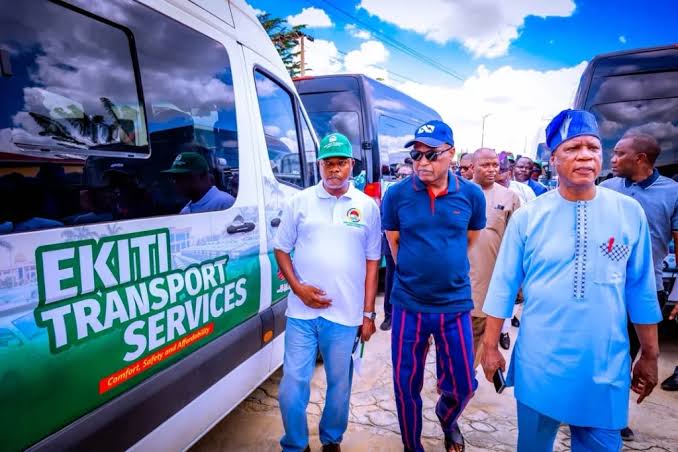
Similarly, the Ekiti State Government has commenced moves aimed at reducing transport fares by 50 per cent across the state, with the deployment of CNG buses to cushion the effect of transportation costs on residents.
The state governor, Mr. Biodun Oyebanji, said the deployment of the CNG buses marked a major step in the government’s move to reduce transport costs for citizens in line with President Tinubu’s directive.
He added that the state had commenced the process of cutting transport fares by 59 per cent through the rollout of 15 CNG buses donated to the state by the federal government as part of efforts to promote affordable and accessible public transportation, adding that the state would expand the fleet of vehicles to serve residents better.
Governor Oyebanji, who was accompanied by the Senate Leader, Senator Opeyemi Bamidele, at the official flag-off of the vehicles at the premises of the Ekiti State Transportation Agency in Ado Ekiti, said the government would continue to explore avenues to reduce the burden on citizens.
Speaking with journalists shortly after inspecting the fleet of vehicles, Governor Oyebanji expressed appreciation to President Tinubu for the intervention, noting that the provision of the buses would contribute significantly to reducing the burden of transportation on the people. He added that the initiative demonstrates the commitment of both the state and federal governments to improving the welfare of the people.
Speaking on the deployment of the buses, the Director-General of the Ekiti State Transportation Agency, Hon. Tajudeen Akingbolu, said routes had been mapped out for the CNG buses to operate from Ado Ekiti to Lagos, Ibadan, Onitsha and Abuja, adding that the initiative would provide residents with more affordable and reliable interstate transportation while reducing the burden of high transport fares.
Lagos recently took delivery of 20 additional high-capacity CNG buses from the federal government. But the state is yet to announce the commencement of the transport fare reduction scheme under the National Affordable CNG Transit Programme.
The latest delivery brings the number of CNG buses in Lagos’ regulated public transport system to about 170, from approximately 150 previously, according to LAMATA Managing Director, Abimbola Akinajo.
The buses are expected to boost capacity on routes with identified gaps, including the Ikorodu-Tafawa Balewa Square corridor.
The Lagos State Government has not publicly announced a new fare structure, specific commencement date or routes under the federal government’s latest fare-reduction intervention.
This is significant because the federal government’s directive was aimed not merely at deploying CNG buses, but at ensuring that the lower operating costs associated with CNG and electric mobility translate into reduced transportation costs for commuters.
In Enugu State, the difference between government-supported transport and commercial operations is also evident.
While fares have been reduced by more than 50 per cent on routes covered by government-owned CNG buses, commercial transport operators have yet to reduce their charges.
The Public Relations Officer of the Road Transport Employers Association of Nigeria (RTEAN), Enugu State chapter, Ralph Edeh, said it was unrealistic to expect operators to cut fares while fuel, spare parts and other costs remained high.
“It is still within the realm of wishful thinking for anybody to ask transport operators to start slashing down fares when the cost of fuel, motor spare parts, among other factors, are still very high,” he said.
The situation is different in Rivers State, where the NURTW chairman, Boma Tom-George, linked any reduction in fares directly to the price of petrol.
“We sell as we buy. Since we are using fuel and fuel price remains where it is. It is when it is reduced that the leadership of the union will also see how to reduce transport costs,” he said.
