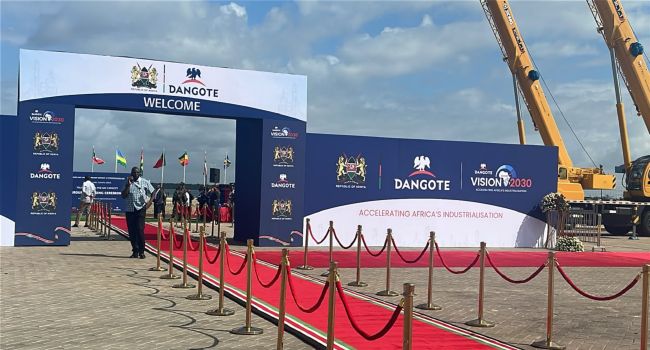
The stage is set for the groundbreaking ceremony of the Dangote East Africa Petroleum Refinery and Petrochemicals SEZ, to be held on Wednesday in Mokowe, Lamu County, Kenya.
The proposed refinery, estimated to cost about $ 16 billion, is expected to have a processing capacity of 700,000 barrels per day and is targeted for completion by 2030.
The facility is planned to process crude from Kenya’s Turkana oilfields as well as supplies from other parts of Africa and is expected to reduce the region’s dependence on imported petroleum products.
Speaking to reporters in Nairobi on Tuesday, Africa’s richest man said he saw it as part of efforts to stop the continent exporting raw materials and start selling finished products.
“By 2030, the majority of African countries will be self-sufficient. It does not matter where it is refined, but it should be in the African continent, on the soil of Africa,” he said in response to a question from AFP on when Africa would no longer need to import fuel from elsewhere.

He dismissed concerns about the Kenyan project, which is being built at Lamu on the picturesque Indian Ocean coast, and already faces a land rights court case and opposition from Greenpeace and others over its environmental impact.
“There’s actually no problem with these sort of cases,” Dangote said. “There are people who don’t want the development of Africa.”
Dangote, who disclosed plans to invest an additional $50 billion across Africa after committing more than $25 billion to existing businesses, said the next phase of the Group’s expansion would combine massive industrial investment with a deliberate opening of its businesses to African ownership through the capital markets.

President Williams Ruto’s chief economic advisor, David Ndii, disclosed that the Lamu project grew out of discussions among African policymakers, financiers and business leaders on how to deploy the continent’s natural resources for industrialisation rather than extraction. According to Ndii, those discussions identified petroleum refining as one of the strategic opportunities for East Africa and led to engagement with Dangote, President William Ruto, Uganda’s President Yoweri Museveni and other regional leaders.
He said a closed-door meeting in April examined an addressable East African market for finished petroleum products estimated at 20 million metric tonnes annually, potentially rising to 30 million tonnes.
He traced the intellectual roots of the project to an earlier Nairobi meeting convened by the President and Chief Executive of Africa Finance Corporation, Samaila Zubairu, which challenged African leaders to reconsider an economic model under which infrastructure readily attracts international financing when designed to evacuate raw materials, but struggles to secure capital when intended to process those resources locally.
Quoting a phrase from Zubairu that he said had stayed with him, Ndii declared: “We export our minerals FOB and import inflation CIF.” He said the Lamu project represented an attempt to reverse that equation.
